

Running Clean
A mini split that looks like this is moving air the way it should, warm or cold depending on the season. The casing is clean, the louvers move freely, and nothing is blocking the flow in or out of the room.
A local pro who knows mini splits gets your details and gets in touch.
Find my proA mini split set to heat mode but still blowing cold air usually comes down to one of a few things. The unit may still be in its startup cycle, where it checks the room before the compressor ramps up to push warm air, and that can take several minutes. It may be set to fan mode instead of heat by mistake. It can also mean a stuck reversing valve, the part that switches the system between heating and cooling, or a refrigerant charge that has dropped too low to move heat properly. If you run this mini split in January and it keeps pushing air that never warms up, that is not something that fixes itself with a new filter or a reset of the thermostat. New Jersey winters are too cold to wait out a heat pump that will not heat, and most homes here lean on gas furnaces for exactly that reason. A mini split that will not hold heat needs a technician to check the valve, the charge and the controls before the next cold stretch.
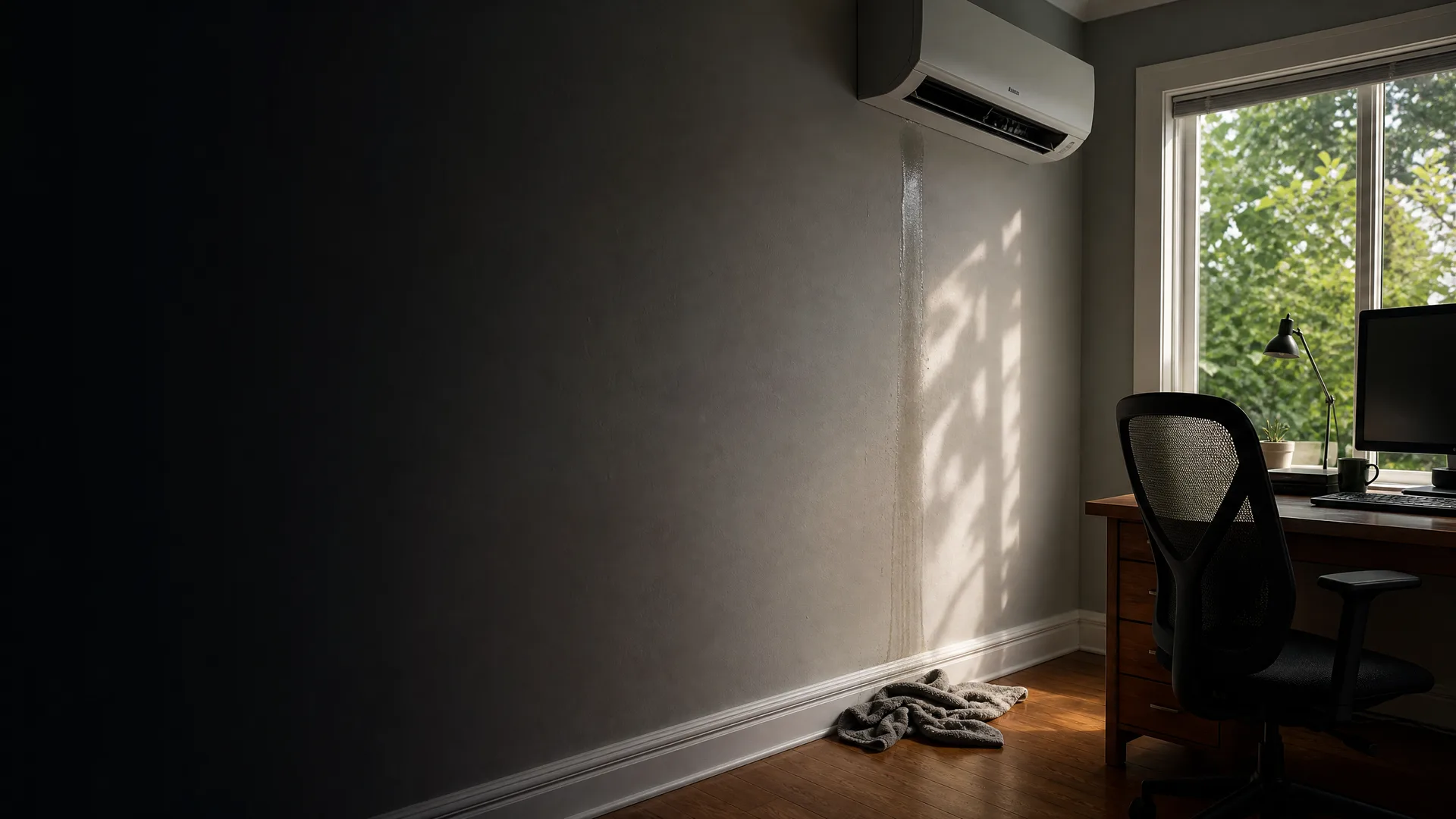
You're working from home on a sticky July afternoon, the mini split up on the wall keeping your office bearable. You glance over and catch it: a wet streak running down the wall underneath the indoor unit. You get up to look closer and feel the drywall is damp to the touch. A towel is already on the floor where water has been dripping onto the baseboard. The unit is still blowing cold air, same as always, like nothing's wrong with it at all. You check the line outside where the condensate should be draining and nothing is coming out. Whatever's backed up, it's finding its way down your wall instead.
You switched the mini split over to heat and stood by the vent waiting for warm air, and what hit your hand was cold. In a New Jersey winter that's not something you want to wait out, especially with gas prices for backup heat running high right now too. You want to know if this is normal startup behavior or something that needs a tech out before it gets colder.
When outdoor temperatures drop toward freezing, the outdoor unit's coil can ice over. The system has to pause heating and run in reverse for a few minutes to melt that ice off, and during that time the indoor head blows cold or cool air because it's briefly acting as the condenser instead of the evaporator. This happens on cold, damp days when a coastal New Jersey winter brings temperatures near 32 degrees with high humidity, which is exactly when ice builds fastest. A defrost cycle that runs a few minutes every hour or so and then goes back to normal heating is working as designed. If the air stays cold for much longer than that, or the outdoor unit looks heavily iced without clearing, a technician should check the reversing valve and the refrigerant charge.





A mini split that looks like this is moving air the way it should, warm or cold depending on the season. The casing is clean, the louvers move freely, and nothing is blocking the flow in or out of the room.

Yellowing like this on the casing usually means years of dust pulled through the unit without the filters being cleaned. A mini split working that hard to push air through a clogged filter is also a mini split more likely to blow cold air when it should be blowing warm.

Most homes around here heat with gas, so the mini split is likely doing one job: keeping a bedroom or addition warm without running the furnace for one room. When it blows cold instead, that room just doesn't get there. You'll find yourself running a space heater next to it, or closing the door and giving up on the space until it's fixed. Either way you're paying twice, once for the mini split sitting there not heating, and again for whatever you're using to make up the difference, and electricity here isn't cheap to burn on a backup plan.
A mini split that's stuck blowing cold in January usually has a specific cause, a reversing valve, a refrigerant charge, a control board, and guessing at it from home rarely fixes it for good. A local contractor who works on these systems all winter has seen this exact complaint enough times to know what to check first in a system like yours, and getting matched with one means one visit, from someone who shows up knowing the likely answer instead of starting from zero.


New Jersey summers run humid, with a dew point that averages 63°F across June, July and August, according to NOAA climate data. Air that heavy is what makes a room feel sticky even when the thermostat says it's cool enough. Your mini split has to pull that moisture out of the air before the room feels right, and that's a different job than just cooling it. If the unit is low on refrigerant or the drain line is clogged, the moisture doesn't go anywhere, and you'll feel it: a clammy room, damp air, maybe a musty smell even with the system running. A local contractor who services mini splits through a New Jersey summer knows what that humidity load does to a unit over a season, and that's the kind of match worth getting, one contractor who knows this climate, not a handful of calls to sort through.
NASA POWER T2MDEW county cells weighted by homes
The pro who reaches out is licensed in New Jersey.
You're not committing to anything by asking.
When it's cold outside, the outdoor unit can frost up, and the mini split runs a defrost cycle to clear it. During that cycle the indoor fan keeps running but the system is pulling heat from the room instead of adding it, so you feel cold air for a few minutes. That's normal on a 30-degree night. If it happens over and over, or the cold air lasts well past ten minutes, the defrost sensor or the reversing valve may not be switching back the way it should, and that's a repair, not something to wait out.
A defrost cycle ends and warm air comes back. A real problem doesn't. If the indoor unit keeps blowing cold with the thermostat set to heat, and it stays that way after the compressor should have kicked in, something is stuck or low. A refrigerant leak, a failing reversing valve, or a sensor reading the room wrong can all cause this, and each one needs a gauge set or a multimeter to confirm. Running it like that through a New Jersey winter just burns power without heating the room.


You can open the panel, pull the filters, and clean what you can reach, and that's worth doing regardless of what's wrong. But a reversing valve, a low charge, or a control board fault isn't something you can see or fix from the panel. Diagnosing those means gauges, electrical testing, and knowing what a normal reading looks like on that specific system. Without that, you're swapping parts and hoping, which costs more in the long run if the first guess is wrong. New Jersey gas prices being what they are, a mini split that's not heating right means the furnace picking up the slack, and that shows up on the bill fast.
A local contractor who services mini splits all year, through humid Jersey summers and cold winters, has likely seen this exact fault on this exact brand before. They know whether a certain model tends to stick its reversing valve, or whether a particular install is prone to low charge from a bad line set connection. That experience means less time guessing and more time fixing the actual problem. When you request service, you're matched with one licensed local contractor, not a handful of companies calling you at once, so the person who shows up is someone who can speak to your system specifically.
At 22.48 cents per kilowatt-hour, a mini split stuck blowing cold air while set to heat isn't just uncomfortable, it's running up your bill while failing to do its job. You're paying to move air that never gets to the right temperature.
EIA-861 2025 statewide residential average
Set to heat and blowing cold has a short list of real causes, and you've seen them all above. The startup cycle explains the first few minutes. A defrost cycle explains a stretch of cold air on a hard freeze night, the outdoor unit clearing frost before it can push warm air again. Past that, you're into a stuck reversing valve, a refrigerant charge that's dropped low, or a control board that's sending the wrong signal to the valve. Those three don't fix themselves. The valve stays stuck until someone swaps it. The charge stays low until someone finds the leak, seals it, and brings the system back to the level it needs. The board stays wrong until it's replaced. None of that shows from the panel, and none of it shows from a clean filter, though cleaning the filter is still worth doing on its own.
While it sits wrong, you're paying New Jersey rates to run a unit that isn't heating the room it's supposed to heat. That's the part that makes waiting the costly option, not the cautious one.
The room it's in probably only has the one system keeping it warm, since gas handles the rest of the house. A contractor who works on mini splits through winters here has likely already seen a reversing valve stick on a system just like yours, and knows what to check first.


Matched to your mini split job
Only one pro gets your request, so you hear from one company.

